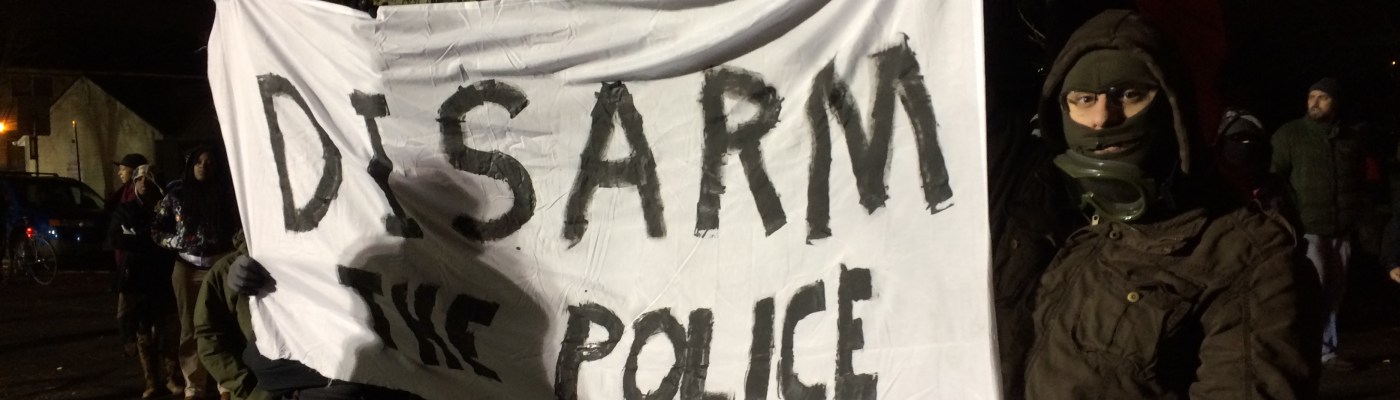
Minneapolis Police’s alleged execution-style shooting of 24-year-old African-American Jamar Clark gained national attention over the past week and sparked a heavy unrest across the city of Minneapolis.
What is actually known about the incident is the subject of great contention.
What is known is that Sunday, Nov. 15 police and ambulances responded to a call concerning domestic assault. Police arrived to find Jamar Clark, the domestic-assault suspect, interfering with the paramedics. Soon, Jamar Clark was on the ground unconscious with a bullet-wound above his eye.
This is what is agreed on. The rest remains subject to debate.
“The young man was just laying there; he was not resisting arrest,” said eyewitness Teto Wilson, as quoted by the local chapter of the NAACP. Supporters of Jamar claim he was handcuffed and compliant when he was shot down.
This differs greatly from the statement released by the Minneapolis Police Department who’s official claim states that Jamar Clark was indeed not handcuffed and was shot while trying to disarm officers.
As news broke about the incident civil unrest among the city unraveled. By later that same afternoon Black Lives Matter had announced a protest.
The plan was to camp out front of the Minneapolis’s 4th precinct indefinitely with a list of demands from the Minneapolis Police Department. The list of demands, posted on their Facebook page are as followed.
- We want to see the footage from the incident.
- We want an independent organization. The BCA [Bureau of Criminal Apprehension] is not independent.
- We want the media to cover eye-witness testimony, not just police’s point of view
- We want community oversight with full disciplinary power.
- We want officers to live in the communities they serve.
The situation quickly escalated.
By Monday protest erupted across the city of Minneapolis. Activists swarmed I-94W, shutting down the freeway for over two hours. Police gave the protesters a 15-minute warning, calling the assembly unlawful. They proceeded to arrest those who refused to leave, resulting in the arrest of 51 people, being bused away on Metro-transit buses to holding cells.
Meanwhile, outside of the 4th precinct the sleep-in continued.
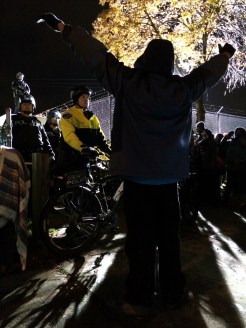
Equipped with tents, fires, and Domino’s pizza, activists circled the precinct. Rod Adams, a worker’s rights organizer for NOC –Neighborhood Organization for Change- stands above the crowd with a megaphone. “These are things that continue to plague our community,” referring to the police brutality inflicted upon the African-American community.
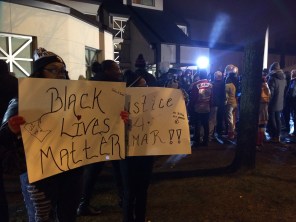
“We want the video evidence, police names, and charges against the police who shot him. We ain’t leaving until we get it. We got tents, warm blankets, we’re good,” said Keith Mercier, an organizer for Black Lives Matter.
“I’m out here for a young brother,” said Harry Maddox, an organizer for NOC. Maddox claimed to have been a victim of systematic discrimination himself. “I was charged with a gun, I didn’t have a gun, I had school books.” Many other demonstrators claimed to have had experienced personal tragedy at the hands of police.
Monique Cullers-Doty, one of the leaders of Black Lives Matter St. Paul, talked about the loss of her nephew at the hands of police this past January.
“My nephew was shot in the back of the head and abandoned in an alley,” said Cullers-Doty. “It’s saddening that we have to protect ourselves from the police.” She added that what she’d like to see is more accountability and better screening of police officers.
“It’s not about training; you can’t train for human decency,” said Cullers-Doty.
Donald Shannon claimed his cousin died during a police interrogation in Chicago eight years ago. The 54-year-old said he thinks police brutality against blacks has only “gotten worse” in his lifetime and that he understands the frustration people have towards police, but that the “people will calm down once they’re respected.”
Since Monday, some of the demands of Black Lives Matter and activists have been met. The names of the officers responsible for the incident have since been revealed as Mike Riggenberg and Dustin Schwarze, both seven-year veterans of the police force that have been in Minneapolis for 13-months.
Videos of the incident have been obtained by the BCA. According to Minneapolis police there is no official body-camera or dash-camera surveillance. However, the BCA did obtain several other videos, including footage by bystanders, although none of the videos show the shooting in its entirety.
BCA Superintendent Drew Evans said no images from the incident would be released until the investigation is complete.
In the interest of transparency, Minneapolis Mayor Betsy Hodges has requested an investigation from the Civil Rights Division of the Department of Justice. This investigation would remain independent from the one that the BCA is already conducting.
On Monday night it was announced that Jamar Clark was pulled off life-support.
Wednesday tensions grew thick outside of the precinct. The protest had accrued hundreds of demonstrators.
As the temperature dropped animosity grew between the demonstrators and on-duty police officers. Demonstrators, led by megaphone, broke into chants. “Prosecute the police. No Justice, No Peace.”
Some impassioned protesters took the liberty of shouting at the lines of police.
“You hate me because of the color of my skin,” shouted one protester.
Friction grew heavy when the police, dressed in riot-control gear, maced some members of the protest.
“Twenty people got it in their eyes. We were just occupying space, not being violent,” said one protester who wished to remain anonymous citing safety concerns.
Demonstrators dispersed surgical masks and gallons of milk poured into water bottles in preparation for another macing. Demonstrators started hanging tarps upon a wired fence to prevent the mace from spreading through the air.
Minneapolis police said they used the mace in response to protestors “throwing bricks” as well as “rocks and bottles”.
Before Wednesday night’s protest, Minneapolis Mayor Betsy Hodges released a statement urging police officers to “exercise maximum restraint” and requested that protestors “act peacefully”. She also said, “I understand that emotions are running high in the community and across the City. I share many of the emotions that people are feeling in Minneapolis today.”
*This story was done in collaboration with another writer.
 Justine Anderson