This story was originally published in Native Sun News Today.
EAGLE BUTTE, South Dakota — The Cheyenne River Sioux and Oglala Sioux tribes are refusing to bow to an order South Dakota Gov. Kristi Noem sent to the two tribes on May 8. The order states the tribes must remove coronavirus traffic checkpoints from reservation borders or face legal action.
The top elected leaders of the state’s largest tribes argue that Constitutional and treaty law establish their tribal sovereignty and authority to protect their people by operating the roadside stops within their boundaries.
“I regretfully decline your request,” Cheyenne River Sioux Chair Harold Frazier said in an immediate response letter to Noem. “I stand with our Councilman Ed Widow that the purpose of our actions is to ‘save lives rather than save face’.” He added, “We will not apologize for being an island of safety in a sea of uncertainty and death.”
The checkpoints are necessary partly due to South Dakota’s slow and ineffective response to the Covid-19 pandemic, according to Oglala Sioux Tribal President Julian Bear Runner.
South Dakota is one of five states that hasn’t issued a shelter-in-place mandate, despite a steady increase in confirmed cases of Covid-19.
“Due to this lack of judgement and planning of preventative measures … , the Oglala Sioux Tribe has adopted reasonable and necessary measures to protect the health and safety of our tribal members and other residents of the Pine Ridge Indian Reservation,” Bear Runner wrote to Noem in another May 8 letter.
The governor’s missive threatened: “If the checkpoints are not removed within the next 48 hours, the state will take necessary legal action.” However, at her weekday pandemic media briefing three days later, she mentioned no specific action in answer to reporters’ questions about the issue.
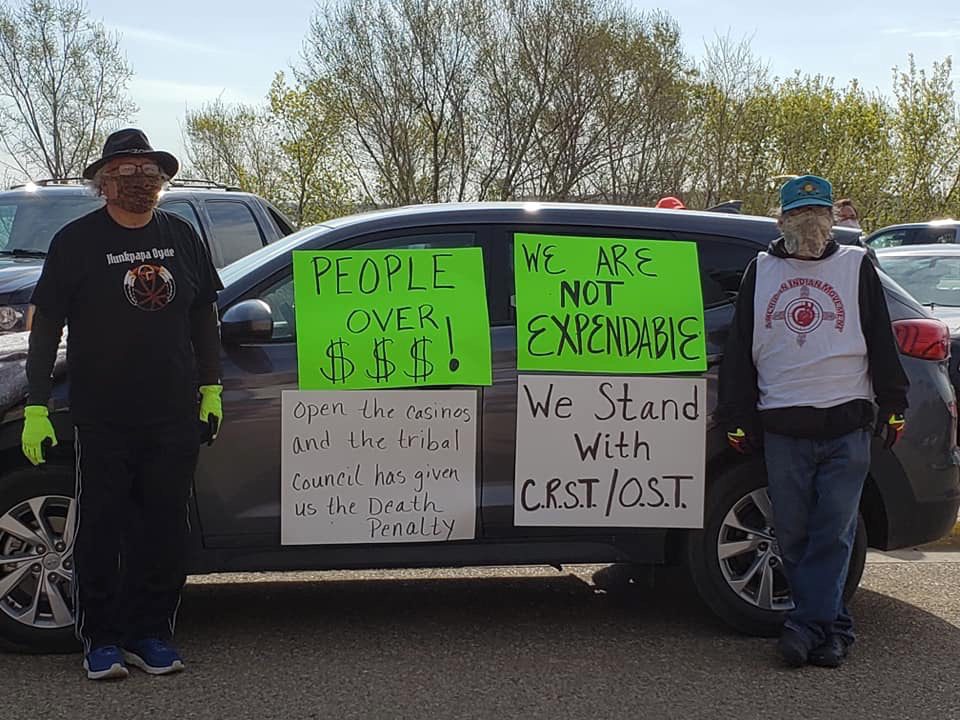
Grassroots response to her order was swift and concerted, as tribal members joined their law enforcement at checkpoints in showing solidarity with the public safety measure.
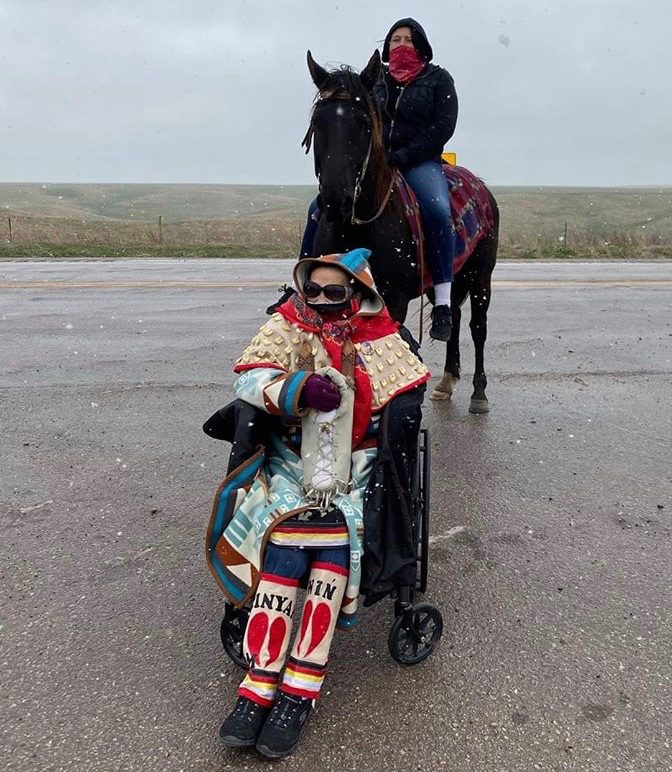
At the Allen eastside checkpoint on Pine Ridge Indian Reservation, the Mato Ota Tiospaye mounted horseback to escort their matriarch and grant her Mother’s Day wish to deliver a statement to Noem.
Despite freezing wind and snow, 89-year-old Unci Emma Waters pulled up her wheelchair with a handprinted sign reading, “This is our land!” She spoke through a handmade mask into a microphone to say, “This is our land, so you cannot say anything!”
Her granddaughter stood beside her, also masked against contagion, to read a longer prepared statement, citing years of case law to establish that “the Oglala Sioux Tribe is a sovereign nation.” It was shared on social media with the message:
“Keep our border patrol here, keeping safe against Covid19! Oglala Lakota Nation, stand strong! This is our land! Since March 13, 2020 our family went into lockdown — no visitors. We made homemade masks, smudged night and day, boiled water, boiled medicine, protected our homes with prayer, prayed for the people…keeping our unci safe, our children safe.
“But there comes a time when enough is enough, so on this day May 10, 2020, with the threat from Gov. Kristi Noem … we stood behind our unci as she made her stand to support the border monitors who have been keeping her and the Oglala Lakota Nation protected!”
Governor Noem and Bureau of Indian Affairs Director Darryl LaCounte have asserted that the checkpoints must be removed because they are in violation of a BIA memorandum declaring that tribes must consult with state officials before “closing or restricting travel on state or U.S. highways.”
Both Chairman Frazier and President Bear Runner insist they have not closed any roads and are using the checkpoints to mitigate and track the spread of the coronavirus.
“Non-residents whose travel is considered non-essential are advised to pass through the reservation without stopping,” wrote President Bear Runner to Noem. “It is not our intent to deny them passage through the reservation, including on U.S. Highway 18 and State Highways 44, 391, and 407.”
At the heart of the debate is the scope of tribal authority on state and federal highways that run through tribal territory. Chairman Frazier and President Bear Runner argue that the law supports the tribes.
In his response to the governor, Frazier cited Article 16 of the 1868 Ft. Laramie Treaty, which “stipulates and agrees that no white person or persons shall be permitted to settle upon or occupy any portion of the same; or without the consent of the Indians first had and obtained, to pass through the same.”
He added that while collaboration is crucial during this time, being forced to remove the checkpoints restricts the fundamental right of the tribe — a sovereign nation — to protect its people.
“I absolutely agree that we need to work together during this time of crisis; however, you are continuing to interfere in our efforts to do what science and facts dictate seriously undermine our ability to protect everyone on the reservation,” wrote Frazier.
The Oglala Sioux Tribe also cited the Ft. Laramie Treaty in its response letter:
“The 1868 Treaty recognizes that our reservation was ‘set apart for the absolute and undisturbed use and occupation’ of our Indian people’,” wrote President Bear Runner. He added that, according to the treaty, outsiders would not “ever be permitted to pass over, settle upon, or reside in [our territory].”
He also referenced South Dakota’s state Constitution, which contains the agreement ,“We, the people inhabiting the state of South Dakota, do agree and declare that we forever disclaim all right and title … to all lands … owned or held by any Indian or Indian tribes …,” S.D. Const., Art. XXII.
Tribal leaders and grassroots members are not the only ones questioning the legality of the governor’s checkpoint removal order.
On May 9, 17 South Dakota state legislators sent a bipartisan letter to Governor Noem’s office arguing that the order violates numerous treaties and court rulings.
“Your statement that tribal governments do not possess the ability to establish checkpoints within the boundaries of their homelands is not accurate,” the letter reads. “These jurisdictional powers were enshrined in both the 1851 and 1868 Ft. Laramie treaties and have been reaffirmed numerous times through case law, Congress, and Supreme Court rulings.”
The legislators then cited a 1990 ruling by the 8th Circuit Court of Appeals in Rosebud Sioux Tribe v. State of S.D., which concludes, “Absent tribal consent, we hold the State of South Dakota has no jurisdiction over the highways running through Indian lands in the state.”
The lawmakers went on to chide Governor Noem for not consulting with those of them who represent districts that include tribal lands.
“…We could have helped facilitate conversations and given your office unique insights as to the history, culture, protocols, and vernacular of how to work together with tribal governments,” the lawmakers wrote.
“You elected, however, not to contact us and sent an ultimatum to both tribes. We think a better approach is communication rather than confrontation, cooperation rather than constitutional crisis and discussion rather than demands.”
The Lakota Law Project has begun a signature drive on a petition titled, “Tell South Dakota to Respect Tribes and Public Safety.“
“South Dakota Governor Kristi Noem failed to mandate basic COVID-19 protections, and now she’s threatened legal action over tribal checkpoints meant to keep the pandemic out of Pine Ridge and Cheyenne River,” the petition says. “Tell her to stand down and protect public health and safety!”
 Justine Anderson